The path where hurrying stops making sense — Woljeongsa, Odaesan
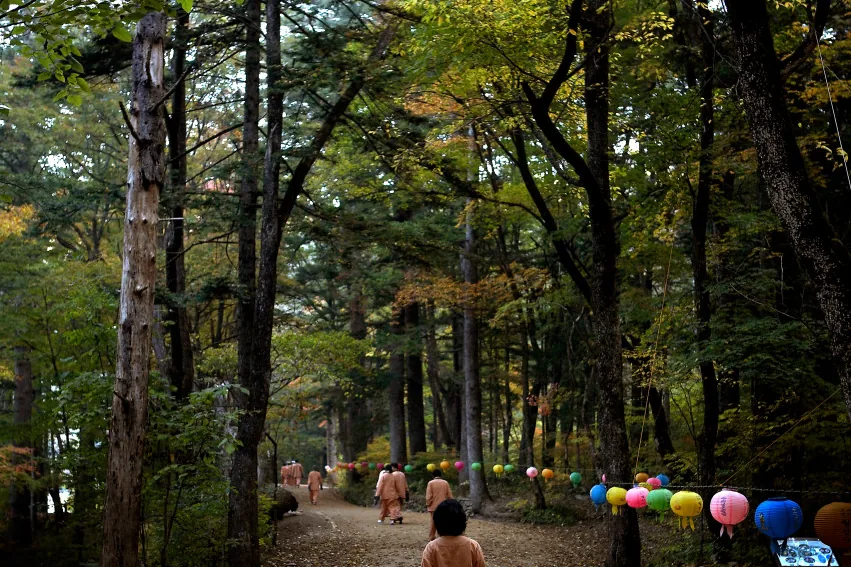
The path into Woljeongsa temple is lined with fir trees. Some of them have stood there for centuries.
It’s about a kilometre from the front gate to the temple — twenty minutes at an ordinary pace. Most people take longer. It’s the kind of path where hurrying stops making sense.
The air in the forest isn’t so much cool as heavy. Wet earth and conifer, and dry leaves breaking underfoot. At a certain point the sound drops away. The trees are dense enough there that nothing from outside reaches you.
If you’ve come here after a procedure, the beauty isn’t the main reason this path works.
The fir tree path at Woljeongsa meets most of the conditions that matter when you’re recovering. It runs roughly a kilometre each way — two kilometres in total — with almost no gradient. The canopy shades nearly the whole route, and there are benches at intervals. In the temple courtyard stands a nine-storey octagonal pagoda from the Goryeo dynasty. When your body isn’t quite what it was, these things matter more than the view.
What makes a path suitable for someone recovering?
Travel writing tends to talk about scenery. How lovely it is, when to visit. If you’ve just had a procedure, you need different information. How far you’ll walk. Whether you can sit down. Whether there’s shade.
The fir tree path comes up often in recovery contexts because it answers all three. No steps, no real incline. Two kilometres is under an hour even at a slow pace, and it’s a distance you can abandon halfway without feeling you’ve missed anything. And in summer you barely see direct sun. Many procedures require keeping the treated area out of UV light — here the trees do that work for you.
The most useful thing about it is that you can stop. There’s no destination you’re obliged to reach, so you can turn back wherever your body decides.
In short The Woljeongsa fir tree path runs approximately 1km from the main gate to the temple, 2km return, on flat ground. There are no steps or steep sections, dense woodland provides shade across most of the route, and seating appears at intervals, so you can turn back according to your energy. How far and how soon you can walk depends on your procedure and recovery, so follow the guidance of the clinic that treated you.
Why have people always gone to old temples to recover?
Stand in the courtyard and you’ll see the nine-storey pagoda. It was raised during the Goryeo dynasty. A great many people have passed through this spot since then. Some of them, certainly, came because they were unwell.
Going to the mountains to recover isn’t a modern idea. It’s a very old one. We’ve simply given it a name.
Woljeongsa is the head temple of the fourth district of the Jogye Order, set into the slopes of Odaesan. There’s a templestay programme, but you don’t have to join it. Some days sitting in the courtyard is enough. When you’re recovering, the urge to accomplish something can get in the way.
The grounds are large but level. A slow circuit takes about half an hour.
In short Woljeongsa is the head temple of the fourth district of the Jogye Order of Korean Buddhism, located on Odaesan in Pyeongchang, Gangwon Province. The grounds contain a nine-storey octagonal pagoda from the Goryeo dynasty, and the courtyard is level, making movement around the site straightforward. A templestay programme runs on site, but visiting the grounds without joining it is entirely possible.
How many times a day should you move?
The hardest part of travelling while you’re recovering isn’t distance. It’s the number of times you have to move. Carrying luggage, getting in and out of a car, adjusting to an unfamiliar room — repeat that and it tires you far more than walking does.
So this route is built around never moving your luggage more than twice in a day. Walk the forest in the morning, return to the hotel in the afternoon, and do nothing. That’s the whole plan.
The accommodation is at Alpensia, half an hour by car from the temple. It sits at around 700 metres on the Daegwallyeong plateau — cool even in August, with restaurants and walking paths inside the resort, so you needn’t get behind the wheel again in the evening.
Leaving parts of the day empty is also a plan. Especially now.
In short When recovering, the number of transitions matters more than the distance travelled. This route pairs a morning walk with an afternoon of rest to keep daily movement to a minimum. Holiday Inn & Suites Alpensia Pyeongchang sits roughly 30 minutes by car from Woljeongsa at about 700m elevation, with dining and walking paths within the resort grounds.
Frequently asked questions
How long does the fir tree path take?
About a kilometre from the main gate to the temple — twenty to thirty minutes at a slow pace, under an hour there and back. There’s almost no gradient, so it feels easier than the distance suggests.
How soon after a procedure can I walk?
That depends heavily on the procedure and on you. Recovery Route doesn’t provide medical guidance, so please ask the clinic that treated you. Generally, building up gradually without pushing is the approach recommended.
Is there enough shade in summer?
The firs are dense enough to shade most of the route. The car park by the main gate and the temple courtyard are open, though, so sun does reach you there. If you’re avoiding UV exposure, bring a hat or parasol.
Can I go in winter?
Yes — snow on the forest path is worth seeing. The surface can be slippery, so you’ll want shoes with proper grip, and take care on any iced sections.
Can I get there without a car?
Woljeongsa is about twenty minutes from Jinbu KTX station by bus or taxi. Getting on to Alpensia is easier with a hire car, though. If you’re relying on public transport, consider staying nearer the station instead.
Walking through a forest doesn’t make your body heal. Time does that.
But you can choose where to spend the time. An afternoon under thousand-year-old trees and an afternoon in a hotel room are the same length and pass entirely differently.
There’s no way to recover faster. There are only better places to wait.
Where to stay
Holiday Inn & Suites Alpensia Pyeongchang 325 Solbong-ro, Daegwallyeong-myeon, Pyeongchang-gun, Gangwon · 30 minutes by car from Woljeongsa
A resort at 700 metres on the Daegwallyeong plateau, with 419 rooms. Many are suites combining beds with ondol — Korean underfloor heating — which is worth choosing if you need warmth to sleep. Restaurants and walking paths are inside the resort, so there’s no need to travel again in the evening.
AffiliateBook — affiliate link
Recovery Route thinks constantly about what proper rest requires. We look for the calmest places we can find, and we note the walking distances, the shade, and where you can sit down.
This article is travel information, not medical advice. Confirm any procedure or aftercare with the clinic that treated you.